 en
en русский
 Español
 عربى
عربى
Industrial PSA Nitrogen Generator Systems: Principles, Performance, Manufacturing, and Applications
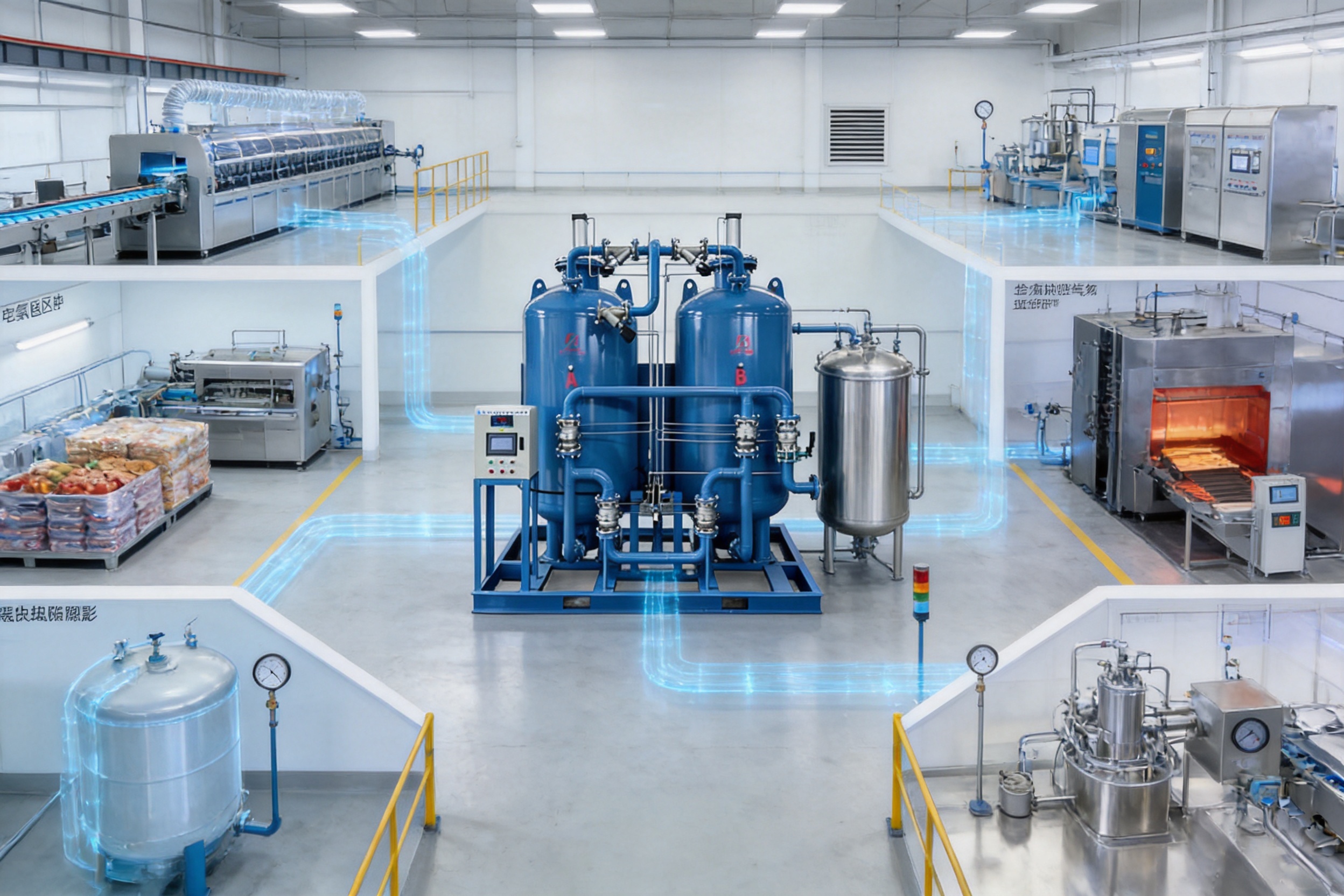
Reliable nitrogen supply is essential in many industrial processes where oxygen, moisture, and uncontrolled atmospheric air can affect product quality, process safety, equipment life, or production efficiency. A pressure swing adsorption nitrogen generator provides an on-site alternative to delivered liquid nitrogen and high-pressure nitrogen cylinders by separating nitrogen from compressed air and producing it continuously at the point of use.
The BAN pressure swing adsorption nitrogen generator is designed for industrial nitrogen production across a broad range of flow rates and purity requirements. It uses high-quality carbon molecular sieve adsorbents, an alternating two-tower adsorption process, compressed-air purification, automatic control, and product-gas buffering to provide a stable nitrogen supply. Depending on the selected configuration, the system can produce nitrogen from approximately 95% to 99.999% purity, with output capacities from small laboratory or workshop requirements to large industrial installations.
This article explains the operating principle, system configuration, technical advantages, manufacturing strengths, performance considerations, applications, and selection factors associated with industrial PSA nitrogen generator units. It also describes how Zhejiang Baiao Gas Equipment Co., Ltd. combines equipment design, fabrication, process optimization, quality control, installation, and after-sales service to deliver customized gas-generation systems.
Content
- 1 What Is a PSA Nitrogen Generator?
- 2 System Configuration and Gas Flow
- 3 Operating Principle of Carbon Molecular Sieve Adsorption
- 4 Advanced Unequal Pressure Equalization
- 5 Advantages of the BAN PSA Nitrogen Generator
- 6 Technical Performance Range
- 7 Representative Model and Capacity Information
- 8 Manufacturing and Engineering Strengths
- 9 Application Areas
- 10 Comparison with Delivered Nitrogen
- 11 Installation and Commissioning Considerations
- 12 Maintenance and Long-Term Reliability
- 13 How to Select the Correct Model
- 14 Company Capabilities and Service Strengths
- 15 Frequently Asked Questions
- 15.1 What is the main function of the BAN nitrogen generator?
- 15.2 How does a two-tower PSA system provide continuous nitrogen?
- 15.3 What nitrogen purity can the system produce?
- 15.4 Why does higher purity require more compressed air?
- 15.5 What is the purpose of the air-purification system?
- 15.6 Can nitrogen pressure be adjusted?
- 15.7 Can the system be customized?
- 15.8 Does the generator include the air compressor?
- 15.9 What happens if the nitrogen purity is temporarily below specification?
- 15.10 What industries use PSA nitrogen?
- 15.11 How should the molecular sieve be protected?
- 15.12 What information should be provided for a quotation?
- 16 Conclusion
- 17 References
- 18 Product: BAN Pressure Swing Adsorption(PSA) Nitrogen Generator
What Is a PSA Nitrogen Generator?
A PSA nitrogen generator is an air separation system that uses pressure swing adsorption to remove oxygen and other unwanted components from compressed air. Atmospheric air is mainly composed of nitrogen and oxygen, with smaller quantities of argon, carbon dioxide, water vapor, and trace gases. The generator does not create nitrogen chemically. Instead, it selectively adsorbs oxygen and allows nitrogen to pass through as the product gas.
The separation process depends on the different adsorption behaviors of oxygen and nitrogen when they contact carbon molecular sieve. Under a suitable pressure, the molecular sieve adsorbs oxygen more readily than nitrogen. Nitrogen therefore becomes enriched in the gas phase and is directed to the product outlet. When the adsorbent approaches its working capacity, the pressure in the adsorption vessel is reduced. The adsorbed oxygen is released during this depressurization and regeneration stage.
Industrial PSA equipment generally uses two or more adsorption vessels. In the BAN configuration, one adsorption tower produces nitrogen while the second tower undergoes depressurization and regeneration. The towers then alternate functions. This alternating cycle allows the equipment to produce nitrogen continuously rather than only in separate batches.
The term “pressure swing” refers to the repeated change between adsorption pressure and regeneration pressure. The pressure cycle, timing, equalization method, purge arrangement, molecular sieve loading, valve performance, and control logic all influence the final nitrogen purity, output, energy consumption, and operating stability.
System Configuration and Gas Flow
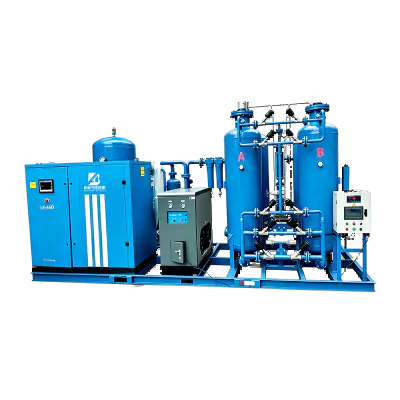
A complete PSA nitrogen plant is more than two adsorption towers. Stable nitrogen production requires a properly designed compressed-air source, air-treatment system, adsorption system, product buffer, automatic control system, valves, instrumentation, and safety devices.
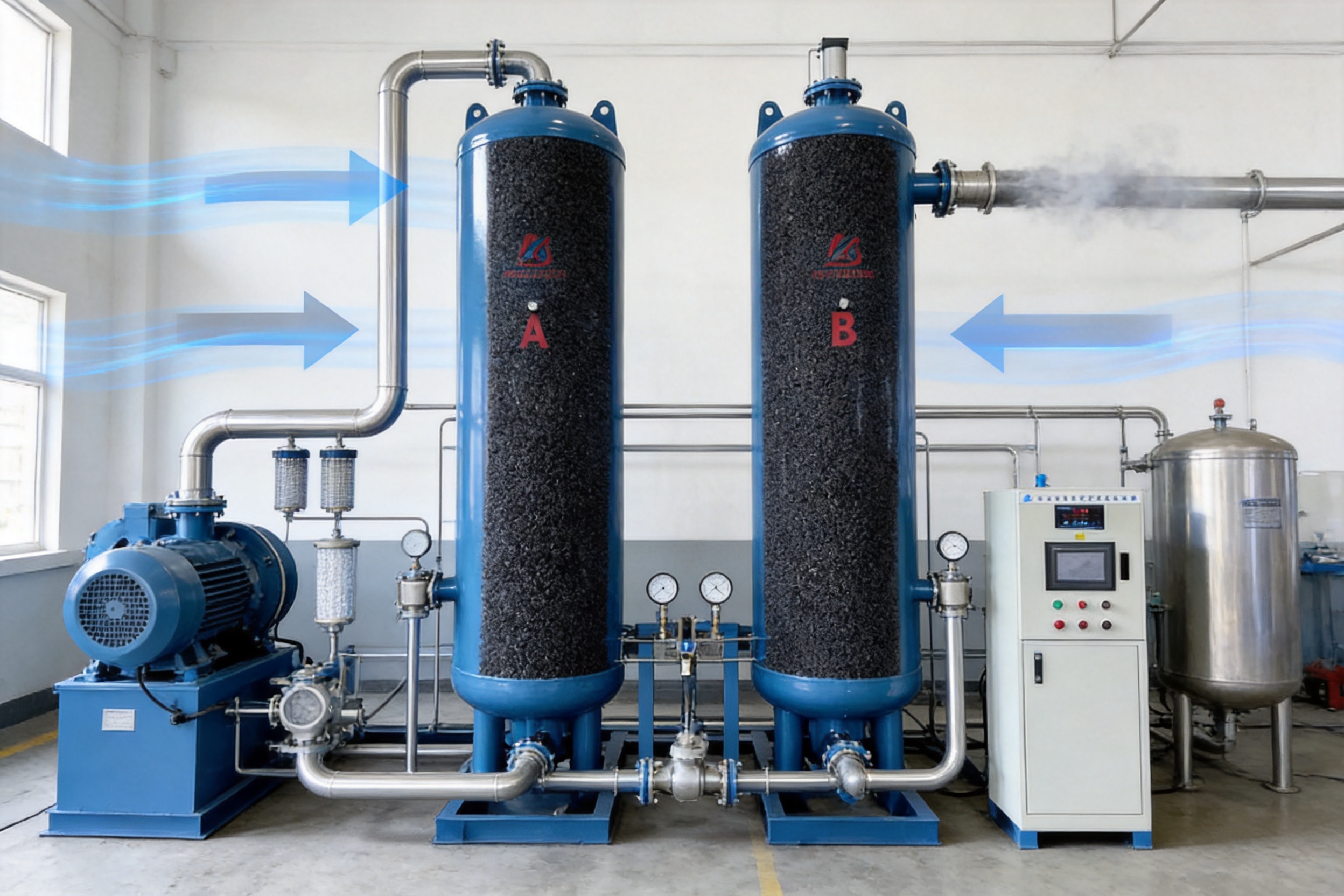
The principal process stages are the air compressor, compressed-air purification system, adsorption system, buffer system, and nitrogen delivery section. The compressor supplies air at the pressure required by the generator. The purification system removes oil aerosols, liquid water, particles, and other contaminants that could damage or contaminate the carbon molecular sieve. The adsorption towers perform oxygen-nitrogen separation. The buffer tank stabilizes product flow and pressure before nitrogen is sent to the user.
Compressed air quality is particularly important. Oil, liquid water, excessive humidity, dust, and compressor carryover can reduce adsorption efficiency and shorten the service life of the molecular sieve. For this reason, the air-treatment section may include refrigerated or desiccant air dryers, coalescing filters, particulate filters, activated carbon filtration, automatic drains, and pressure regulation components according to the application requirements.
Once treated compressed air enters the active adsorption tower, oxygen is preferentially retained by the carbon molecular sieve. Nitrogen passes through the tower and enters the product-gas line. A portion of the product nitrogen may be used for purging the regenerating tower, while the remainder is directed to the buffer tank or process user. During regeneration, the inactive tower is depressurized and the oxygen-rich gas is discharged safely.
The buffer system helps reduce short-term fluctuations caused by tower switching and variations in user demand. It also supports smoother pressure control, improves product-gas continuity, and provides a reserve volume during brief changes in the adsorption cycle.
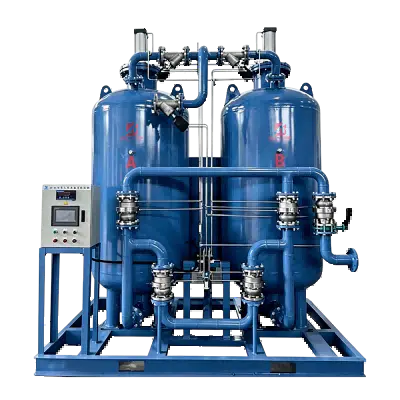
BAN Pressure Swing Adsorption(PSA) Nitrogen Generator
Operating Principle of Carbon Molecular Sieve Adsorption
Carbon molecular sieve is a specialized porous adsorbent with a structure that promotes the selective adsorption of oxygen from air. Its performance is based on both surface adsorption and kinetic separation. Oxygen molecules diffuse into the microporous structure more rapidly than nitrogen molecules under the operating conditions of the generator.
At elevated pressure, the adsorption capacity of the molecular sieve increases. Oxygen is captured more strongly, while nitrogen remains comparatively concentrated in the gas phase. At reduced pressure, the equilibrium loading of oxygen decreases, allowing the adsorbent to release the retained oxygen. The molecular sieve can then be reused in the next production cycle.
The adsorption and regeneration process must be carefully balanced. If the adsorption period is too long, the molecular sieve may become saturated and oxygen may break through into the nitrogen product. If the cycle is too short, the available adsorption capacity may not be fully used and compressed-air consumption may increase. The control system therefore regulates valve timing and tower sequencing to maintain the required purity and output.
The BAN system uses a two-adsorption-tower process. During the production phase, one tower operates at adsorption pressure and delivers nitrogen. At the same time, the other tower is depressurized and regenerated. Depending on the model and operating requirements, the sequence may include pressure equalization or unequal pressure equalization steps. These steps transfer gas between towers or between process sections to recover useful pressure energy and improve adsorbent utilization.
Advanced Unequal Pressure Equalization
Pressure equalization is an important factor in the efficiency of a PSA system. Traditional equal-pressure equalization attempts to balance the pressure between vessels in a relatively symmetrical manner. An unequal pressure equalization process uses a controlled pressure difference and carefully timed gas transfer to make better use of the compressed air already present in the system.
The purpose of unequal pressure equalization is to reduce unnecessary venting and lower the amount of compressed air required for a given nitrogen output. By recovering part of the gas and pressure contained in the adsorption system, the process can improve carbon molecular sieve utilization and reduce the energy demand imposed on the air compressor.
Actual savings depend on nitrogen purity, inlet pressure, ambient conditions, product flow, cycle timing, and the condition of the adsorbent. Nevertheless, process optimization at the equalization stage can provide an important advantage over basic PSA designs that release more gas during tower switching.
The equalization sequence is managed by the programmable logic controller and coordinated with the switching valves. Proper valve response is essential. A valve that opens too slowly, closes incompletely, or leaks during the equalization stage can disturb the pressure profile and increase gas consumption. This is why reliable valve selection and accurate control logic are central elements of an efficient generator.
Advantages of the BAN PSA Nitrogen Generator
Ready-to-Use Integrated Configuration
The system is arranged as an integrated nitrogen-generation unit rather than a collection of unrelated components. The compressor interface, air-purification equipment, adsorption vessels, buffer system, valves, control cabinet, and instrumentation can be coordinated as one process package. This simplifies installation planning and allows users to obtain a system configured for their required flow rate and purity.
A complete system can be supplied with the major process equipment assembled, tested, and prepared for connection to the customer’s compressed-air and nitrogen distribution lines. This reduces field assembly work and helps shorten the time between delivery and commissioning.
Wide Nitrogen Purity Range
One important benefit of PSA technology is its flexibility. The BAN product range is designed for nitrogen purity levels from approximately 95% to 99.999%. Lower purity nitrogen generally requires less compressed air per unit of product, while higher purity requires more intensive separation and a higher air-consumption ratio.
This range allows one technology platform to serve several industries. Nitrogen at approximately 95% to 98% purity may be suitable for inerting, blanketing, certain metal-treatment operations, and fire-prevention applications. Nitrogen at 99% or higher may be used for food packaging, chemical protection, heat treatment, and general process protection. Very high-purity nitrogen, including up to 99.999%, may be required in electronics, specialized heat treatment, laboratory, and precision manufacturing applications.
Purity can be adjusted through control settings and system configuration. The final specification should always be established using the customer’s required oxygen content, flow rate, pressure, dew point, operating hours, and process conditions.
Energy-Conscious Operation
The largest operating cost of a PSA nitrogen plant is usually the electricity used by the air compressor. The generator’s process design therefore has a direct effect on operating economics. The unequal pressure equalization process, optimized adsorbent loading, efficient airflow distribution, appropriate cycle control, and low-loss valves are intended to reduce compressed-air consumption.
The supplied technical data show different effective air-consumption values for different purity levels. In general, higher purity requires more air because more oxygen must be removed and additional purge or regeneration gas may be required. Selecting a purity level that matches the actual process requirement is one of the most effective methods of reducing energy consumption.
Oversizing the generator can also increase operating costs. A system should be selected according to the required continuous flow, peak demand, operating pressure, purity tolerance, and future expansion plans. A properly matched generator can operate more efficiently than a much larger unit running continuously at a low load.
Intelligent Monitoring and Automatic Operation
The system uses Siemens PLC automatic program control according to the supplied product information. The controller manages tower switching, valve timing, pressure sequences, alarm signals, product discharge, and optional automatic venting of off-specification nitrogen.
Automatic control reduces the need for manual intervention and helps maintain repeatable operating conditions. It can also provide operating data and alarm information to support preventive maintenance. A reserved communication interface may be configured for remote monitoring or computer-based control, subject to the final project design.
An optional automatic unqualified-nitrogen venting device can prevent nitrogen that does not meet the selected purity value from entering the user’s process. This feature is valuable in applications where oxygen breakthrough could affect safety, product quality, or production consistency.
Reliable Valve and Flow-Distribution Design
PSA systems perform many switching cycles over their operating life. Valves must therefore open and close rapidly, seal reliably, withstand repeated pressure changes, and maintain low internal leakage. The product design emphasizes valves with fast response, low gas consumption, straightforward construction, good sealing performance, convenient installation, and maintainable valve seats.
Internal components are also important. Air distribution devices help spread compressed air evenly through the molecular sieve bed and reduce localized high-velocity flow. Uniform distribution minimizes channeling, reduces mechanical impact on the adsorbent, and supports consistent oxygen removal across the vessel cross-section.
Protection of the Molecular Sieve
The carbon molecular sieve is the core separation material, and its condition strongly affects generator performance. The equipment uses reliable upstream gas-source treatment to reduce exposure to oil, water, particles, and other contaminants. Proper filtration and drying help protect the adsorption bed and maintain its working capacity.
The system also incorporates automatic cylinder compression technology according to the supplied technical description. An alarm can be issued when a shortage of carbon molecular sieve is detected in an adsorption tower. This alerts the operator to inspect the vessel and correct the condition before excessive movement, pulverization, or premature performance loss occurs.
The filling method is also significant. Stretching and twisting filling technology is used to make the molecular sieve bed more uniform and dense. A properly filled bed reduces voids, limits particle movement, lowers friction effects, and improves the reliability of long-term operation.
Technical Performance Range
The standard technical range includes nitrogen flow rates from approximately 5 to 3,000 Nm³/h, nitrogen purity from approximately 95% to 99.999%, adjustable nitrogen pressure from approximately 0.1 to 0.8 MPa, and a dew point range of approximately -40°C to -73°C at atmospheric pressure. Exact performance depends on the selected purity, flow rate, raw-air pressure, air quality, ambient temperature, humidity, elevation, and project configuration.
The manufacturer’s parameter tables include multiple purity groups, including 97%, 98%, 99%, 99.9%, 99.99%, and 99.999% nitrogen. Each purity group has different model sizes, effective gas consumption, pipe diameters, and equipment dimensions. This structure enables users to select a more appropriate balance between purity and production capacity instead of applying one fixed specification to every project.
| Performance Item | Indicative Range or Configuration | Selection Consideration |
|---|---|---|
| Nitrogen flow rate | Approximately 5–3,000 Nm³/h | Based on continuous demand, peak demand, and future capacity |
| Nitrogen purity | Approximately 95%–99.999% | Determined by process safety, product quality, and oxygen tolerance |
| Nitrogen pressure | Approximately 0.1–0.8 MPa, adjustable | Matched to the plant distribution system and point-of-use pressure |
| Dew point | Approximately -40°C to -73°C at atmospheric pressure | Selected according to moisture sensitivity and process conditions |
| Adsorbent | Carbon molecular sieve | Selected according to purity, air quality, pressure, and cycle conditions |
| Control platform | Automatic PLC control, with optional remote interface | Configured according to monitoring and plant integration requirements |
| Process arrangement | Two alternating adsorption towers | One tower produces while the other regenerates |
The published reference conditions for the parameter data are compressed-air pressure of 0.8 MPa gauge, gas consumption measured as the actual flow before entering the adsorption cylinder, ambient temperature of 20°C, elevation of 0 meters, and relative humidity of 80%. When the installation site differs from these conditions, the final design should be recalculated.
Representative Model and Capacity Information
The product family covers small and large capacities. For approximately 99.5% nitrogen purity, models range from BAN-5 at about 5 Nm³/h to BAN-3000 at about 3,000 Nm³/h. For approximately 97% purity, the range extends from models around 10 Nm³/h to BAN3500-97 at approximately 3,500 Nm³/h. Other purity groups include models for approximately 98%, 99%, 99.9%, 99.99%, and 99.999% nitrogen.
The following table presents selected representative capacities rather than reproducing every model in the product schedule. It is intended to show how output and effective air consumption change with purity and capacity. Final technical values should be confirmed for the specific quotation and site conditions.
| Purity Group | Representative Model | Nominal Nitrogen Output | Effective Gas Consumption | Typical Use of the Configuration |
|---|---|---|---|---|
| Approximately 97% | BAN100-97 | 100 Nm³/h | Approximately 4 Nm³/min | General inerting and industrial protection |
| Approximately 98% | BAN100-98 | 100 Nm³/h | Approximately 4.2 Nm³/min | General process protection and blanketing |
| Approximately 99% | BAN100-99 | 100 Nm³/h | Approximately 5 Nm³/min | Food, chemical, and manufacturing applications |
| Approximately 99.9% | BAN100-39 | 100 Nm³/h | Approximately 6 Nm³/min | Higher-purity industrial protection |
| Approximately 99.99% | BAN100-49 | 100 Nm³/h | Approximately 10 Nm³/min | Precision processes and demanding inert atmospheres |
| Approximately 99.999% | BAN100-59 | 100 Nm³/h | Approximately 11.5 Nm³/min | Very high-purity nitrogen requirements |
The effective gas-consumption figures illustrate an important engineering principle: higher nitrogen purity normally requires a greater compressed-air input for the same product flow. Customers should not select a high-purity model solely because the purity appears attractive. The correct selection is the lowest purity that safely and reliably satisfies the process specification, unless future process expansion or quality requirements justify additional purity.
Manufacturing and Engineering Strengths
Integrated Research, Design, and Production
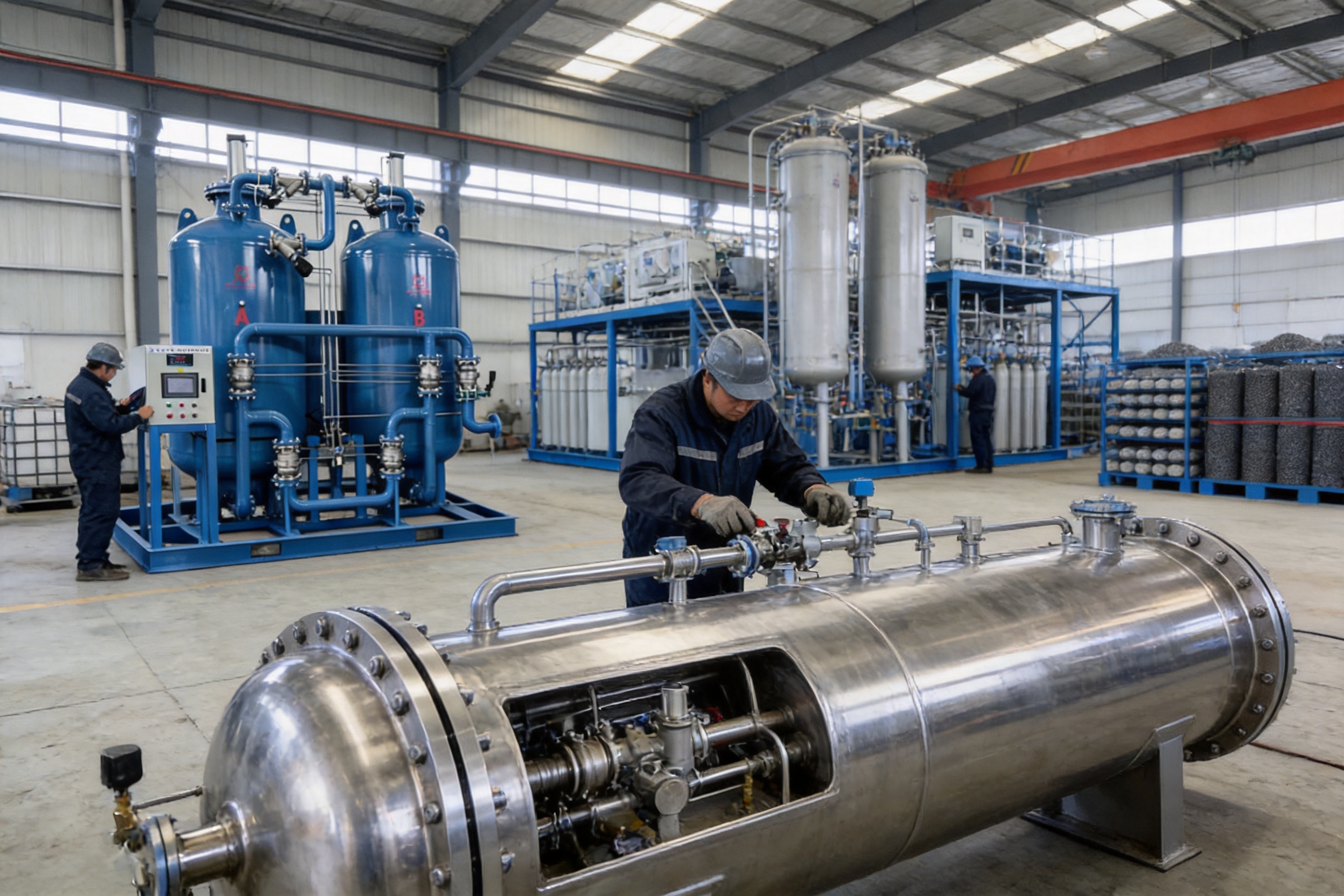
Zhejiang Baiao Gas Equipment Co., Ltd. integrates research and development, engineering design, production, installation, and after-sales service. This integrated structure allows the company to coordinate the technical design with fabrication and commissioning requirements rather than treating each stage as a separate activity.
The company operates a standardized workshop of approximately 3,000 square meters, supported by office and warehouse facilities. A dedicated production environment helps organize vessel fabrication, piping assembly, equipment integration, control-panel preparation, component storage, inspection, and dispatch.
For a gas-generation project, the ability to connect design decisions with manufacturing execution is valuable. Details such as nozzle orientation, pipe diameter, valve accessibility, instrument placement, skid arrangement, electrical cabinet location, and maintenance clearance can be considered during the design stage and verified during assembly.
Customized Process Engineering
Industrial users rarely have identical requirements. One customer may need low-purity nitrogen at a high flow rate for tank blanketing, while another may require a smaller quantity of very high-purity gas for an electronics process. Some sites have limited floor space. Others require outdoor installation, explosion-resistant configuration, remote monitoring, special electrical standards, or integration with an existing compressor room.
The company’s product range supports customized solutions based on gas flow, purity, pressure, dew point, ambient conditions, installation area, operating schedule, and industry requirements. Customization may include the selection of purification equipment, adsorption vessels, molecular sieve type, valves, control components, buffer tanks, pipe connections, filters, dryers, and product-gas monitoring devices.
Engineering review should also consider the compressed-air compressor. The compressor must supply the required flow at the proper pressure while allowing for pressure losses through filters, dryers, pipes, valves, and the adsorption system. A generator cannot achieve its rated output if the air source is undersized or if the inlet air quality does not meet the design assumptions.
Selection of Molecular Sieve and Internal Components
The manufacturer cooperates with recognized domestic and international molecular sieve suppliers and can select products according to the user’s operating conditions. This is important because adsorbent performance is not determined only by nominal purity. The molecular sieve must also be compatible with the inlet pressure, humidity, temperature, cycle time, regeneration method, expected service life, and target flow rate.
Internal distributors, support screens, retaining structures, compression devices, and gas-flow channels are designed to maintain a stable adsorption bed. The purpose is to reduce channeling, protect the particles from excessive movement, and ensure that air contacts the adsorbent as evenly as possible.
Uniform filling is another manufacturing consideration. Voids or uneven density can cause preferential flow paths. Such channeling may lead to oxygen breakthrough, unstable purity, localized wear, and lower usable capacity. A controlled filling process helps make the bed more consistent throughout the tower.
Control and Instrumentation Capability
The automatic control system is responsible for coordinating a complex sequence of pressure changes and valve operations. The PLC program must account for adsorption time, depressurization, regeneration, equalization, repressurization, product delivery, alarms, and optional off-specification gas discharge.
Instrumentation can include pressure transmitters, pressure switches, flow meters, oxygen analyzers, dew-point monitors, temperature indicators, valve position feedback, and alarm devices. The exact instrumentation package depends on the project’s control philosophy and the level of process monitoring required by the customer.
Remote communication capability can be useful for plants with centralized supervision. Operators may be able to monitor nitrogen purity, pressure, flow, alarm status, operating hours, and maintenance information from a control room or computer interface. Remote control functions must be designed with appropriate access protection and safety interlocks.
Application Areas
Electronics and Semiconductor Manufacturing
Nitrogen is used in electronics production to reduce exposure to oxygen and moisture during soldering, component assembly, reflow, storage, and other controlled-atmosphere processes. A stable nitrogen supply can help reduce oxidation and support consistent manufacturing conditions.
Surface-mount technology production may use nitrogen in reflow ovens and selective soldering equipment. The required purity depends on the soldering process, component sensitivity, product standard, and factory quality system. Higher-purity systems may be considered where oxygen concentration must be tightly controlled.
Heat Treatment and Metallurgy
Nitrogen can serve as a protective gas for bright annealing, protective heating, sintering, and treatment of metallurgical or magnetic materials. The gas reduces direct contact between heated materials and atmospheric oxygen, helping limit oxidation and discoloration.
Heat-treatment users must evaluate flow stability, furnace pressure, temperature, gas distribution, residual oxygen, and dew point. The nitrogen generator should be selected to meet both the normal continuous demand and the gas requirement during furnace loading, purging, or process transitions.
Food Processing and Packaging
In food applications, nitrogen can be used for modified-atmosphere packaging, tank blanketing, grain storage, and preservation of vegetables and fruit. It may also be used in alcohol packaging and other operations where oxygen reduction helps protect flavor, freshness, or shelf life.
Food-grade applications require appropriate filtration, sanitary practices, materials compatibility, and product-gas quality verification. A sterilizing filter may be added to the nitrogen outlet when required by the process and applicable regulations.
Chemical and Petrochemical Processing
Chemical plants use nitrogen for tank blanketing, line purging, displacement, pressure transfer, chemical reaction protection, and prevention of unwanted oxidation. Nitrogen can reduce the oxygen concentration above a liquid product and help limit the risk of flammable mixtures in selected processes.
Petrochemical and natural-gas facilities may use nitrogen for container and pipeline purging, leak testing, inerting, maintenance operations, and selected enhanced oil-recovery processes. These applications require careful hazard analysis, proper ventilation, oxygen monitoring, pressure relief, and compliance with site safety procedures.
Pharmaceutical Production
Pharmaceutical facilities may use nitrogen for storage, conveying, mixing, packaging, and protection of raw materials or finished products. Nitrogen can help reduce oxidation and protect moisture-sensitive materials when the system is designed with suitable filtration and cleanliness controls.
The purity and dew point requirements should be established with reference to the product, process validation plan, applicable good manufacturing practices, and the required gas quality standard. The nitrogen generator may be combined with sterile filtration, additional purification, or a dedicated distribution system.
Cable, Rubber, Automotive, and General Manufacturing
Nitrogen is used in the production of cross-linked cables and as a protective gas in selected cable processes. Rubber manufacturing may use nitrogen in tire curing, molding, or other operations where an inert atmosphere is beneficial.
Automotive manufacturing uses nitrogen in heat treatment, laser cutting, welding support, tire filling, component protection, and other processes. General manufacturing sites may use on-site nitrogen to replace cylinders or bulk deliveries for applications such as tank blanketing, metal processing, fire prevention, and equipment purging.
Other sectors that may benefit from PSA nitrogen include aerospace, metallurgy, textiles, mining, energy, and specialized machinery production. The most appropriate system depends on the process hazard, gas quality requirement, operating hours, and available utilities.
Comparison with Delivered Nitrogen
Delivered nitrogen is often supplied in cylinders, liquid-nitrogen dewars, or bulk storage tanks. These methods can be practical for small or intermittent consumption, but they also involve delivery schedules, storage requirements, rental charges, handling procedures, and possible supply interruptions.
An on-site PSA nitrogen generator produces gas when compressed air and electricity are available. It can reduce dependence on external deliveries and provide a more predictable supply for continuous industrial operations. The customer also gains more control over production pressure, purity, operating schedule, and system expansion.
PSA is not automatically the best solution for every application. Very small users with occasional demand may find cylinders more convenient. Extremely high-purity applications may require additional purification or another separation technology. The correct decision should compare the total cost of ownership, including energy, maintenance, equipment investment, gas storage, logistics, safety, and production continuity.
| Factor | On-Site PSA Nitrogen | Delivered Cylinder or Bulk Nitrogen |
|---|---|---|
| Supply method | Produced at the point of use | Delivered and stored on site |
| Logistics | Reduced dependence on delivery schedules | Requires regular ordering and delivery coordination |
| Operating cost | Primarily electricity, maintenance, and compressed air | Gas purchase, delivery, rental, and handling costs |
| Scalability | Can be configured for a broad range of flow rates | Capacity depends on storage and delivery arrangements |
| Purity flexibility | Configured according to process requirements | Usually supplied at the distributor’s standard purity |
| Site requirements | Needs compressor, power, ventilation, and maintenance space | Needs storage, handling, and safety arrangements |
| Supply continuity | Available while utilities and equipment are operating | Dependent on stock and delivery reliability |
Installation and Commissioning Considerations
The installation site should have a stable power supply, adequate ventilation, sufficient floor strength, and enough clearance for inspection and maintenance. The equipment foundation must support the operating weight and minimize vibration. Large systems may require a detailed layout review for transportation, lifting, access, and connection to existing plant utilities.
The compressed-air system should be installed with suitable upstream filtration and drying. Pipework should be clean, pressure-rated, and appropriately sized to avoid excessive pressure loss. Drainage arrangements should prevent liquid water from entering the adsorption system. The nitrogen outlet should be connected to a buffer tank or distribution header according to the process design.
During commissioning, the system should be checked for pipe cleanliness, valve orientation, electrical connections, instrument calibration, pressure resistance, air leakage, drain operation, control sequence, alarm function, oxygen analyzer response, and product-gas discharge. The generator should be operated until the nitrogen purity and pressure stabilize before the product is introduced into a sensitive process.
Where an automatic unqualified-gas venting system is installed, its operation should be tested during start-up and after maintenance. The discharge location must be designed so that oxygen-enriched exhaust gas and nitrogen-rich gas do not create hazards in occupied areas. Nitrogen is not toxic, but it can displace oxygen in confined or poorly ventilated spaces.
Maintenance and Long-Term Reliability
Routine maintenance is essential for stable PSA operation. Filter elements should be inspected and replaced according to pressure drop, operating hours, contamination level, and the manufacturer’s maintenance schedule. Drains should be checked to confirm that condensate is removed effectively.
The compressor, dryer, filters, valves, pressure instruments, oxygen analyzer, PLC cabinet, and molecular sieve vessels should be included in the maintenance plan. Operators should monitor nitrogen purity, product pressure, air consumption, cycle stability, abnormal noise, excessive vibration, valve response, and unexpected pressure fluctuations.
Oil carryover is a serious risk for carbon molecular sieve. The compressor and coalescing filtration system should therefore be maintained carefully. Any sign of oil contamination, water carryover, or filter bypass should be investigated promptly.
Valve maintenance is particularly important because PSA generators perform repeated switching cycles. Leakage through a valve can cause purity loss, increased air consumption, unstable pressure, or premature adsorbent saturation. Valve actuation time and sealing performance should be checked during planned inspections.
The molecular sieve should be protected from mechanical shock and contamination. If the control system indicates a shortage of adsorbent or unusual bed movement, the tower should be inspected. Timely correction can help prevent particle pulverization and prolong the service life of the adsorption bed.
How to Select the Correct Model
The first selection parameter is the required nitrogen flow rate. The design should distinguish between average demand, peak demand, start-up demand, purge demand, and future expansion. A buffer tank can help manage short-term fluctuations, but it should not be used to compensate for a permanently undersized generator.
The second parameter is nitrogen purity. Users should identify the maximum oxygen concentration permitted by the process rather than selecting the highest available purity by default. Higher purity generally increases compressed-air consumption and equipment cost.
The third parameter is delivery pressure. The required pressure at the point of use must account for pipe losses, filters, control valves, and any pressure reduction or boosting equipment. If the user requires pressure above the generator’s normal operating range, a downstream booster may be necessary.
The fourth parameter is dew point. Moisture-sensitive applications may require a lower dew point and additional drying capacity. The specified dew point should be understood in relation to the measurement pressure and test method.
The fifth parameter is the installation environment. Temperature, humidity, elevation, dust, corrosive gases, hazardous-area classification, indoor or outdoor installation, and available maintenance space can all affect the final configuration.
The sixth parameter is the compressed-air source. The compressor must provide sufficient flow at the required pressure, and its output should remain stable during the PSA cycle. The customer should provide compressor details, existing air-treatment equipment, air storage volume, and operating schedule during the technical inquiry stage.
Company Capabilities and Service Strengths
Zhejiang Baiao Gas Equipment Co., Ltd. is located in Fuyang District, Hangzhou, Zhejiang Province, China. The company focuses on gas separation and purification equipment and combines product development, engineering design, manufacturing, installation, commissioning, and after-sales support.
Its product portfolio includes PSA nitrogen generators, PSA oxygen generators, membrane nitrogen and oxygen generators, QH and QC series nitrogen purification units, and ammonia decomposition hydrogen purification equipment. This broader product range enables the company to evaluate different gas-generation and purification technologies when developing a solution for a particular customer.
The company’s equipment is used in petrochemical, textile, food-processing, automotive, heat-treatment, and SMT electronics industries. Its domestic sales network covers more than 30 provinces and cities, while its products are also supplied to international markets.
The company emphasizes technical improvement, quality control, energy efficiency, integrity, responsibility, innovation, and customer service. These strengths are relevant to PSA projects because a nitrogen generator is a process system rather than a simple standalone machine. Long-term performance depends on correct engineering, component matching, assembly quality, commissioning, operating guidance, and continued support.
Frequently Asked Questions
What is the main function of the BAN nitrogen generator?
The main function is to separate nitrogen from compressed air by selectively adsorbing oxygen on carbon molecular sieve. The system delivers nitrogen at a specified flow rate, purity, and pressure for industrial use.
How does a two-tower PSA system provide continuous nitrogen?
One tower adsorbs oxygen and produces nitrogen while the second tower is depressurized and regenerated. The towers alternate roles through an automatic control sequence, allowing continuous product-gas production.
What nitrogen purity can the system produce?
The stated product range covers approximately 95% to 99.999% nitrogen purity. The available flow rate and effective air consumption depend on the selected purity level and model.
Why does higher purity require more compressed air?
Higher purity means that more oxygen must be removed from the feed air. The process may also require additional regeneration or purge gas. As a result, the air-consumption ratio generally increases as the required nitrogen purity rises.
What is the purpose of the air-purification system?
The air-purification system removes particles, liquid water, oil aerosols, and other contaminants before compressed air enters the adsorption towers. Clean and dry feed air protects the molecular sieve and supports stable nitrogen purity.
Can nitrogen pressure be adjusted?
The stated nitrogen pressure range is approximately 0.1 to 0.8 MPa, with adjustment according to the system design. Actual pressure at the point of use depends on the generator, buffer tank, pipework, valves, and any downstream equipment.
Can the system be customized?
Yes. Configuration can be adapted to flow rate, purity, pressure, dew point, ambient conditions, installation space, electrical requirements, control functions, filtration, buffer volume, and industry-specific needs.
Does the generator include the air compressor?
The complete plant configuration can be designed around an air compressor, but the final supply scope should be confirmed in the quotation. Existing compressors may be used if their flow, pressure, air quality, and operating condition meet the project requirements.
What happens if the nitrogen purity is temporarily below specification?
An optional automatic unqualified-nitrogen venting device can discharge off-specification gas instead of allowing it to enter the process. This feature is particularly useful during start-up, tower switching, abnormal conditions, or changing demand.
What industries use PSA nitrogen?
Applications include electronics, SMT production, heat treatment, metallurgy, food packaging, grain storage, chemical processing, petrochemicals, oil and gas, pharmaceuticals, cable manufacturing, rubber production, automotive manufacturing, aerospace, and general industrial protection.
How should the molecular sieve be protected?
The molecular sieve should be protected with effective air filtration and drying, stable compressor operation, correct pressure control, uniform tower filling, reliable valve switching, and regular maintenance. Oil and liquid-water carryover should be prevented.
What information should be provided for a quotation?
The customer should provide the required nitrogen flow, purity, pressure, dew point, operating hours, peak demand, installation location, ambient conditions, available compressed-air source, power supply, preferred control functions, and any hazardous-area or industry-specific requirements.
Conclusion
The BAN pressure swing adsorption nitrogen generator is an industrial on-site gas-generation system based on selective oxygen adsorption by carbon molecular sieve. Its two-tower operating sequence, unequal pressure equalization process, automatic PLC control, buffer system, air purification, reliable valves, and molecular-sieve protection features are designed to provide stable and economical nitrogen production.
The broad range of flow rates and purity levels allows the system to serve both small users and large industrial plants. The main performance advantages come from matching the generator to the actual process requirement, using clean and dry compressed air, selecting the correct molecular sieve, optimizing the adsorption cycle, and maintaining the equipment properly.
Zhejiang Baiao Gas Equipment Co., Ltd. supports this product with integrated research, design, manufacturing, installation, commissioning, and after-sales service. Its standardized workshop, engineering capabilities, product range, component selection, and experience across multiple industries support the development of customized gas-separation solutions.
For an accurate technical selection, the final model should be determined using verified site conditions rather than nominal flow alone. A properly engineered PSA nitrogen plant can reduce dependence on delivered gas, improve supply continuity, support process safety, and provide a flexible long-term nitrogen source for modern industrial production.
References
1. Product technical information for the BAN Pressure Swing Adsorption Nitrogen Generator, including operating principle, advantages, model ranges, and performance data.
2. Compressed air treatment and gas purification principles for industrial PSA systems.
3. General engineering practices for carbon molecular sieve adsorption and pressure swing gas separation.
4. Industrial nitrogen applications in electronics, heat treatment, food processing, chemical production, petrochemical operations, and pharmaceuticals.
5. Manufacturer-provided technical conditions for nitrogen flow, purity, pressure, dew point, air consumption, and reference operating environments.
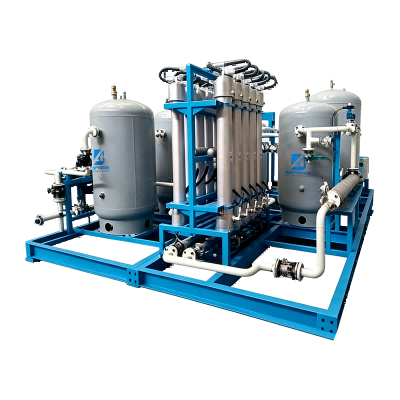
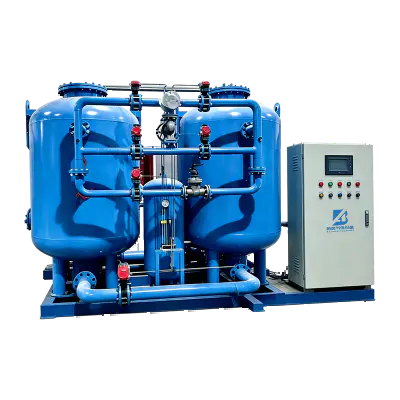
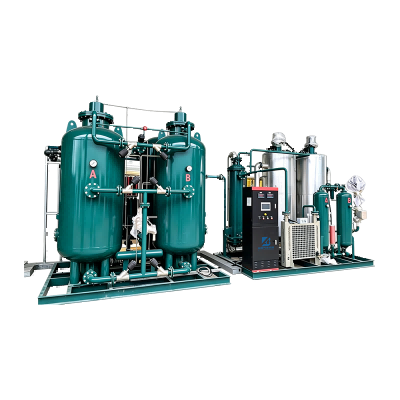
Product: BAN Pressure Swing Adsorption(PSA) Nitrogen Generator

- Tel: +86-15057127179
+86-13588382771 - Email: huang.yifan0215@gmail.com
- Address: Huanshan Township, Fuyang District, Hangzhou City, Zhejiang Province
Copyright © Zhejiang Baiao Gas Equipment Co., Ltd. All Rights Reserved.
Privacy
Gas Generator Plant Manufacturer, Industrial Purification Equipment Plant
