 en
en русский
 Español
 عربى
عربى
Waste Heat Regeneration Adsorption Dryers for Efficient Compressed Air Purification
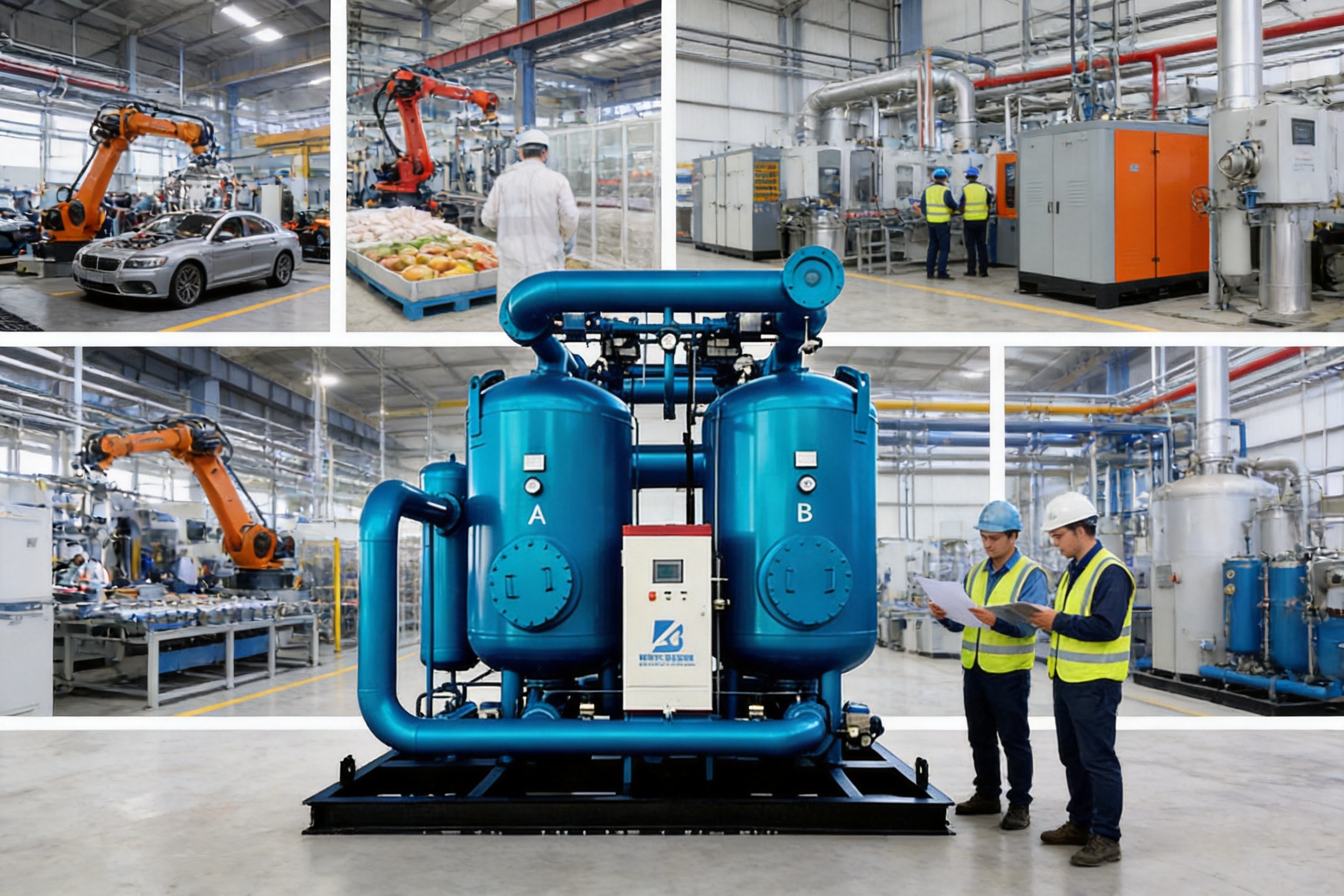
Reliable compressed air is essential in modern manufacturing. It supports pneumatic instruments, automated production lines, packaging systems, control valves, instrumentation, cutting equipment, electronics assembly, and many other industrial processes. However, compressed air leaving an air compressor usually contains moisture, oil aerosols, solid particles, and other contaminants. If these impurities are not removed, they can cause corrosion, product contamination, valve failure, instrument malfunction, pipeline blockage, and costly unplanned maintenance.
The BGD Blower-type Thermal Regeneration Adsorption Equipment is designed to provide a dependable solution for compressed air drying and purification. It is a waste heat regeneration dryer that uses the high-temperature exhaust gas and available thermal energy from an air compressor to regenerate the desiccant. Unlike conventional heated regeneration dryers or heatless regeneration dryers, this system combines temperature swing adsorption with pressure swing adsorption and makes practical use of energy that would otherwise be discharged into the atmosphere.
With a double-tower structure, intelligent switching process, air cooling, vapor-liquid separation, silencing, and optional auxiliary electric heating, the equipment is suitable for industrial facilities that require stable, low-dew-point compressed air while also seeking to reduce operating costs. Its design reflects the growing demand for energy efficiency, reliable automation, reduced compressed-air losses, and integrated gas purification solutions.
This article explains the operating principle, major components, performance advantages, application areas, selection considerations, manufacturing capabilities, and service strengths associated with this type of thermal regeneration adsorption equipment.
Content
- 1 1. The Importance of Dry Compressed Air
- 2 2. Product Overview
- 3 3. Working Principle
- 4 4. Main Components and Their Functions
- 5 5. Advantages Compared with Conventional Dryer Technologies
- 6 6. Competitive Position in Industrial Applications
- 7 7. Manufacturing and Engineering Strengths
- 7.1 7.1 Integrated Product Development
- 7.2 7.2 Standardized Manufacturing Facilities
- 7.3 7.3 Experience in Gas Separation and Purification
- 7.4 7.4 Technology Adapted to Industrial Conditions
- 7.5 7.5 Quality Control and Process Discipline
- 7.6 7.6 Customized Engineering Solutions
- 7.7 7.7 Installation and After-Sales Support
- 8 8. Application Areas
- 9 9. System Selection Considerations
- 10 10. Installation and Commissioning
- 11 11. Operation and Maintenance
- 12 12. Energy-Saving Strategy
- 13 13. Safety and Reliability
- 14 14. Why Choose an Integrated Gas Equipment Manufacturer
- 15 15. Recommended Project Evaluation Process
- 16 16. Frequently Asked Questions
- 16.1 Q1: What is a waste heat regeneration dryer?
- 16.2 Q2: How does the BGD equipment operate continuously?
- 16.3 Q3: Is this equipment the same as a heatless adsorption dryer?
- 16.4 Q4: Is it the same as a conventional heated regeneration dryer?
- 16.5 Q5: What happens if the compressor does not provide enough waste heat?
- 16.6 Q6: What industries can use this dryer?
- 16.7 Q7: What information is required for equipment selection?
- 16.8 Q8: Does the dryer remove oil and solid particles?
- 16.9 Q9: How can operators know that the dryer is working correctly?
- 16.10 Q10: How often does the desiccant need to be replaced?
- 16.11 Q11: Can the system be customized?
- 16.12 Q12: Why is after-sales support important?
- 17 17. Conclusion
- 18 References
- 19 Product: BGD Blower-type Thermal Regeneration Adsorption Equipment
1. The Importance of Dry Compressed Air
Atmospheric air naturally contains water vapor. When air is compressed, the concentration of moisture increases, and the temperature of the compressed air rises. As the air cools downstream of the compressor, part of the water vapor condenses into liquid water. Additional moisture may remain in vapor form and later condense inside compressed-air receivers, pipelines, valves, filters, and end-use equipment.
Liquid water and water vapor can create several operational problems. Corrosion may develop in carbon-steel pipework and storage vessels. Pneumatic cylinders may lose smooth movement. Solenoid valves can stick or become unreliable. Instrument air systems may experience inaccurate readings or control failures. In food, pharmaceutical, chemical, electronics, and coating applications, moisture can directly affect product quality.
Drying the compressed air is therefore not simply a matter of improving convenience. It is a fundamental part of protecting the complete compressed-air system. The correct dryer must be selected according to the required pressure dew point, ambient conditions, compressed-air flow, operating pressure, contamination level, regeneration energy, and production schedule.
Adsorption dryers are commonly selected when a low pressure dew point is needed. They use a solid desiccant to attract and retain water vapor from compressed air. Because the desiccant eventually becomes saturated, it must be regenerated. A twin-tower design allows one tower to dry the process air while the second tower is regenerated. The towers then alternate functions in a controlled cycle.
2. Product Overview
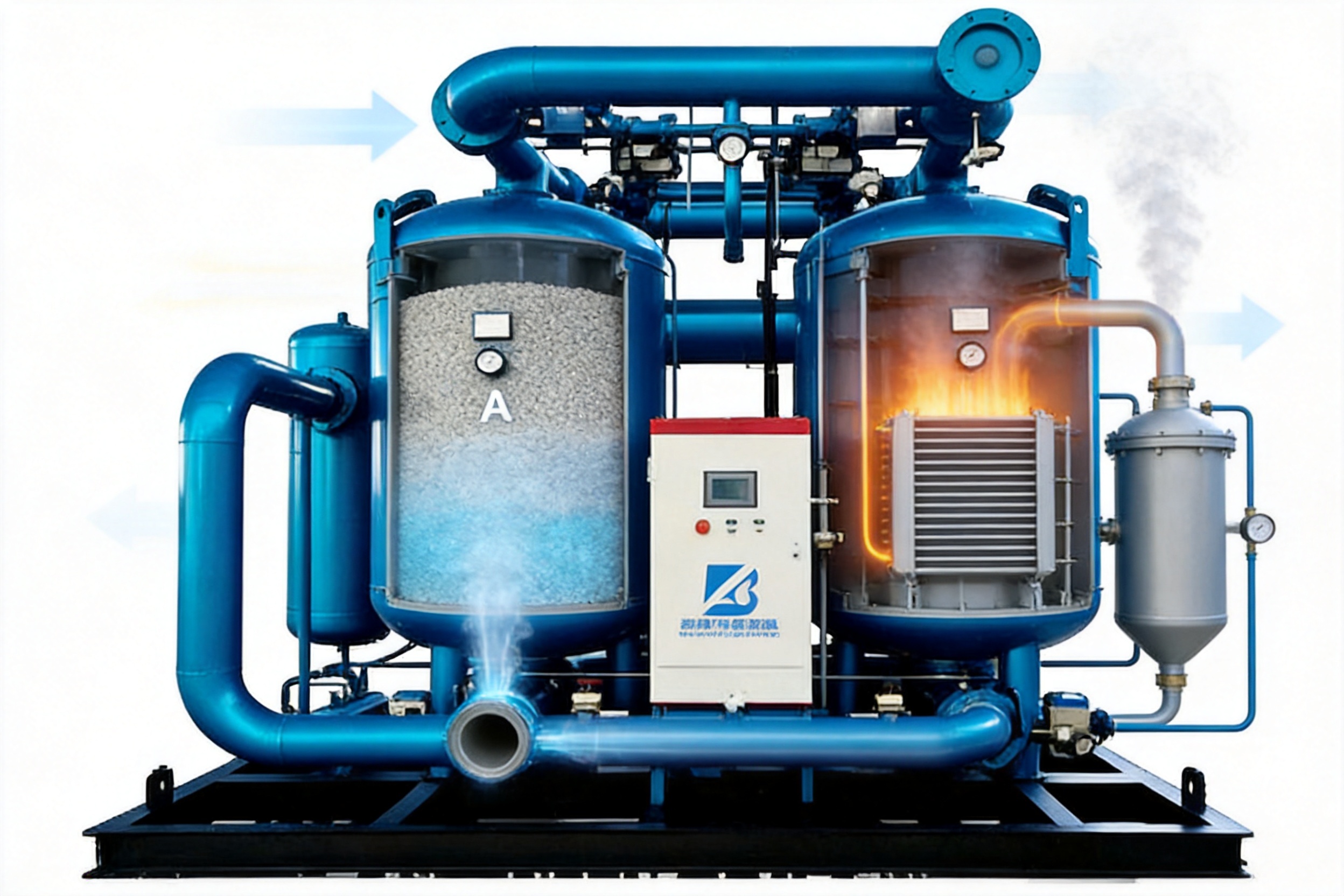
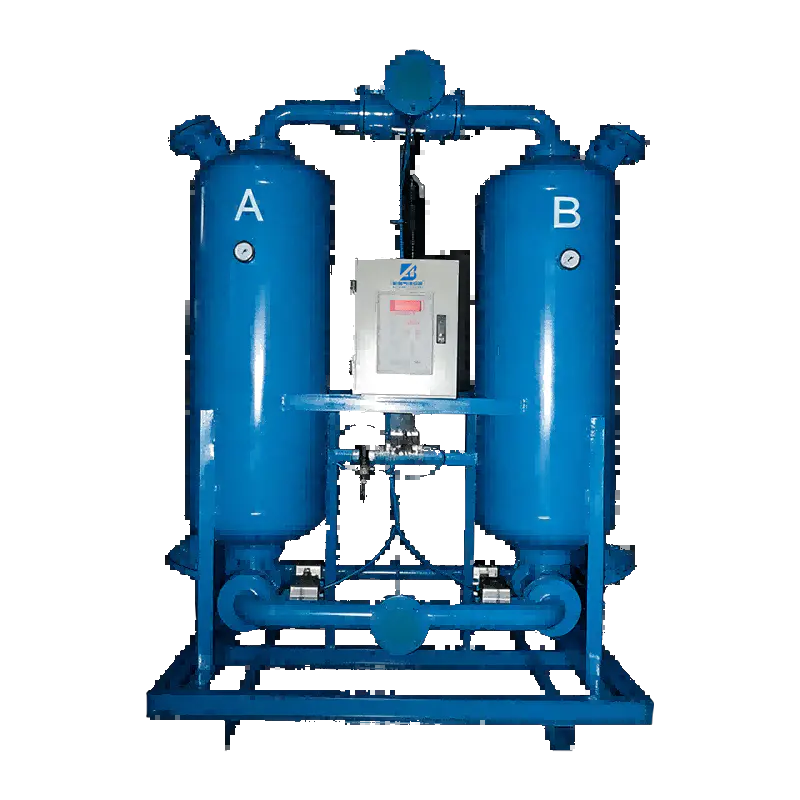
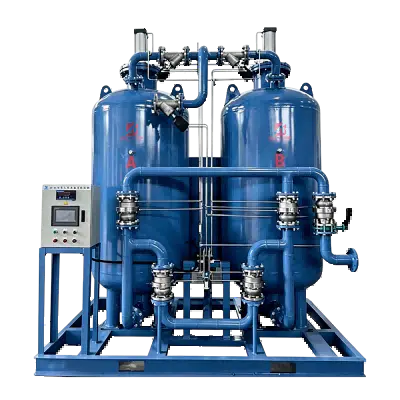
The BGD Blower-type Thermal Regeneration Adsorption Equipment is a double-tower compressed-air drying system based on thermal and pressure swing adsorption principles. One adsorption tower performs the drying process, while the other tower undergoes desorption and regeneration. After the regeneration stage is completed, the control system changes the operating positions of the switching valves and transfers the towers to the opposite functions.
The system is described as a waste heat regeneration dryer because it uses the heat available from the high-temperature exhaust gas of the air compressor. Instead of relying entirely on external electric heaters, the equipment transfers this otherwise wasted heat to the desiccant inside the regeneration tower. The thermal energy helps remove adsorbed water from the desiccant, restoring its moisture-removal capacity for the next drying cycle.
The equipment is neither a traditional heatless dryer nor a conventional heated regeneration dryer. A heatless dryer generally consumes a portion of dried compressed air for desiccant regeneration. A heated dryer uses external electrical or steam energy to heat the regeneration gas. The BGD concept combines the benefits of thermal regeneration with the pressure-swing operating sequence and uses the compressor’s own waste heat as the primary regeneration energy source.
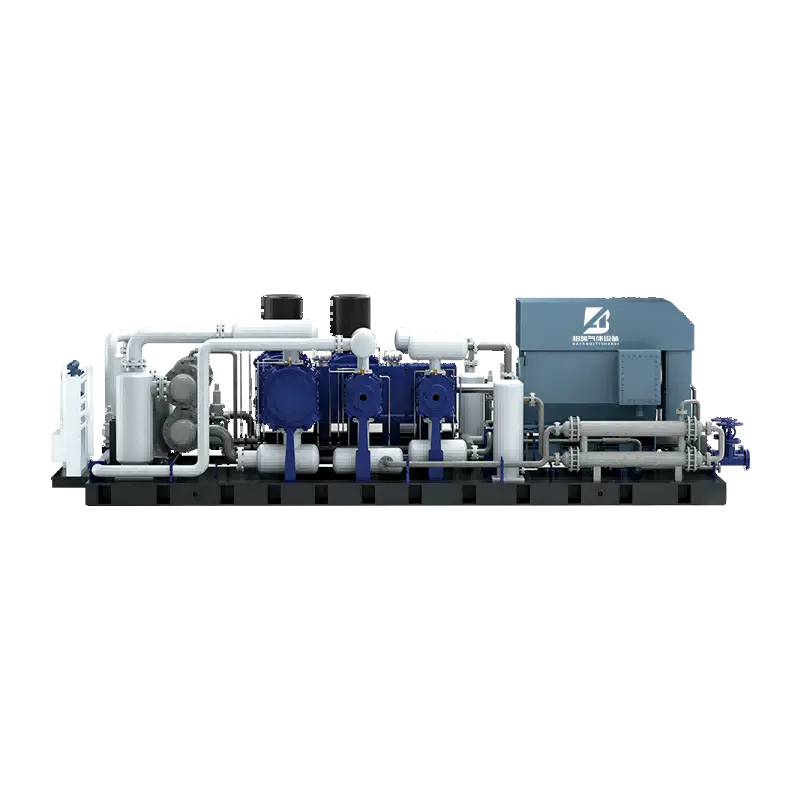
Its main equipment normally includes two adsorption towers, a silencer system, an air cooler, a vapor-liquid separator, switching valves, a control system, and an air-source processing unit. An auxiliary electric heating system may also be installed when the available waste heat is insufficient during startup, low-load operation, cold weather, or special operating conditions.
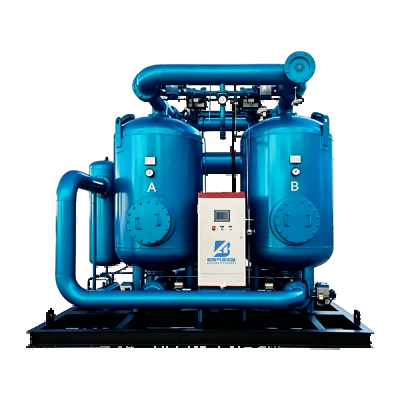
BGD Blower-type Thermal Regeneration Adsorption Equipment
3. Working Principle
3.1 Adsorption Stage
During the adsorption stage, wet compressed air enters the operating adsorption tower. The air passes through a bed of desiccant, where moisture is captured by the adsorbent material. Depending on the design requirements, the desiccant may be selected from materials such as activated alumina, silica gel, molecular sieve, or another suitable drying medium.
The dry compressed air leaves the adsorption tower and proceeds to the downstream production system. The tower remains in adsorption service for a predetermined period or until the control system determines that a switching operation is required. The operating time depends on the air flow, inlet moisture load, pressure, temperature, desiccant type, tower dimensions, and desired outlet dew point.
As the adsorption cycle continues, the desiccant gradually accumulates moisture. A mass-transfer zone moves through the desiccant bed. Proper vessel sizing and cycle control are important because the mass-transfer zone must remain within the tower during the intended adsorption period. If the cycle is too long, moisture may reach the outlet and cause dew-point deterioration. If the cycle is too short, the desiccant capacity is not fully utilized.
3.2 Regeneration Stage
While one tower produces dry compressed air, the second tower is regenerated. Regeneration begins with the controlled preparation of the tower and the removal or reduction of internal pressure, depending on the selected process sequence. The waste heat from the air compressor is then directed through the regeneration system to heat the desiccant.
As the desiccant temperature rises, its ability to retain water decreases. The moisture previously captured during adsorption is released as vapor. The regeneration gas carries this vapor out of the tower. The heated gas may then pass through a cooling stage and a vapor-liquid separation stage before discharge or further treatment, depending on the detailed design.
After the main heating phase, a cooling or pressure-balancing stage may be used to prepare the regenerated tower for return to adsorption service. Controlled cooling is important because a very hot desiccant bed may affect the outlet temperature of the product air or reduce adsorption performance during the first part of the next cycle.
3.3 Tower Switching
When the drying tower approaches the end of its adsorption period and the regeneration tower has completed the required regeneration sequence, the control system initiates tower switching. The valves change position in a controlled order to avoid sudden pressure shocks, excessive flow velocity, and unnecessary mechanical stress.
The regenerated tower is gradually pressurized before it enters adsorption service. At the same time, the saturated or nearly saturated tower is removed from the product-air path and placed into regeneration service. This alternating operation enables continuous production of dry compressed air.
Valve sequencing, timing accuracy, sealing performance, and pressure equalization are important factors in the overall reliability of the dryer. A well-designed control system helps maintain stable operation and can reduce the risk of incomplete regeneration, high pressure drop, or product-air contamination.
4. Main Components and Their Functions
4.1 Twin Adsorption Towers
The two vertical adsorption towers are the central vessels of the system. They are filled with an appropriate quantity of desiccant and designed to withstand the specified working pressure, temperature, and cyclic loading conditions.
The twin-tower arrangement provides continuous service. One tower is always available for adsorption while the other is regenerated. The internal air-distribution structure must be designed to promote uniform flow through the desiccant bed. Uneven distribution may create channeling, localized saturation, excessive pressure drop, or premature dew-point breakthrough.
The tower design also considers desiccant support, retaining screens, inlet distributors, outlet collectors, inspection access, drainage requirements, and replacement procedures. Proper mechanical design protects the desiccant from excessive abrasion and helps maintain stable performance over an extended operating period.
4.2 Desiccant Bed
The desiccant is responsible for removing water vapor from the compressed air. Selection depends on the target pressure dew point, inlet moisture conditions, operating pressure, regeneration temperature, expected service life, and contamination risk.
A suitable desiccant must provide adequate adsorption capacity and withstand repeated heating, cooling, pressurization, and depressurization cycles. It should also maintain mechanical strength and resist crushing or powder formation. Desiccant dust can increase pressure drop and may travel downstream if filtration is inadequate.
Because oil contamination can reduce adsorption capacity, upstream filtration and oil separation are important. The air-source processing unit helps protect the desiccant by removing liquid water, oil aerosols, and solid particles before the air enters the adsorption tower.
4.3 Waste Heat Utilization System
The waste heat regeneration system is a defining feature of this equipment. High-temperature exhaust gas from the air compressor is used as a thermal source for regenerating the desiccant. Heat recovery may be arranged through a direct or integrated process configuration, subject to the compressor design and project conditions.
Using compressor waste heat can reduce dependence on external electrical power. The actual energy-saving effect depends on the compressor type, exhaust temperature, load profile, operating hours, system design, ambient conditions, and regeneration requirements. Nevertheless, the concept offers a practical way to recover energy already generated during compression.
The waste heat path must be carefully engineered to ensure that the temperature delivered to the regeneration tower is suitable for the desiccant and equipment materials. Excessively high temperature may damage components or accelerate desiccant deterioration, while insufficient temperature may result in incomplete regeneration.
4.4 Air Cooler
The air cooler reduces the temperature of the regeneration gas or process stream before the next stage of separation or discharge. Cooling improves the ability of the vapor-liquid separator to remove condensed water and helps protect downstream valves, instruments, and pipework.
Heat-exchanger selection considers flow rate, inlet temperature, ambient temperature, cooling medium, allowable pressure drop, fouling conditions, and maintenance requirements. Proper cooler performance contributes to stable operation throughout seasonal temperature changes.
4.5 Vapor-Liquid Separator
After cooling, part of the moisture carried by the regeneration gas may condense. The vapor-liquid separator removes this liquid phase from the gas stream. Reliable separation helps prevent water carryover and supports cleaner discharge conditions.
The separator may include internal demisting or flow-distribution components, an automatic drain, inspection access, and a connection for condensate management. Drain performance is important because accumulated liquid can reduce effective separation volume and create an additional source of corrosion or carryover.
4.6 Switching Valves
The switching valves control the direction of compressed air, regeneration gas, cooling gas, and pressure-equalization flow. They operate repeatedly during the dryer’s service life, so their design must account for cycle frequency, pressure differential, temperature, sealing, actuator response, and maintenance access.
High-quality valves reduce leakage and help maintain the intended process sequence. Valve selection also affects compressed-air loss, pressure stability, noise, and long-term operating cost.
4.7 Silencer System
Rapid pressure changes and regeneration discharge can generate noise. The silencer system reduces acoustic emissions and improves the working environment around the equipment. It may be installed at exhaust points where high-velocity gas is released during depressurization or regeneration.
A suitable silencer should provide effective noise reduction without creating excessive back pressure. It must also be compatible with the gas temperature, flow rate, moisture content, and maintenance conditions of the application.
4.8 Control System
The control system manages tower switching, valve actuation, regeneration timing, heating assistance, temperature monitoring, pressure monitoring, alarm functions, and operating status display. Automatic control allows the dryer to maintain repeatable cycles without continuous manual intervention.
Depending on project requirements, the system may support local control, remote monitoring, fault indication, communication with a plant control system, and data recording. Important signals can include inlet and outlet pressure, tower temperature, regeneration temperature, valve position, dew point, drain status, and system alarm conditions.
4.9 Optional Auxiliary Electric Heating
Waste heat is the preferred regeneration energy source, but operating conditions may not always provide sufficient heat. The optional auxiliary electric heating system can support startup, low compressor load, temporary compressor shutdown, cold ambient conditions, or special regeneration requirements.
Using electric heating as an auxiliary rather than the primary energy source can preserve operational flexibility while maintaining the energy-saving objective of the system. The control logic can be configured to activate the heater only when necessary, subject to the project’s safety and process requirements.
5. Advantages Compared with Conventional Dryer Technologies
5.1 Lower External Energy Demand
The most important advantage of waste heat regeneration is the use of energy already available from the compressor. In a conventional heated regeneration dryer, electric heaters must supply the energy required to raise the regeneration gas and desiccant to the required temperature. The BGD configuration can reduce this external energy requirement by recovering compressor exhaust heat.
The resulting operating cost depends on the specific installation, but the principle is straightforward: energy that would otherwise be rejected can be redirected to the regeneration process. For facilities operating compressors for long periods, even a moderate reduction in dryer energy demand may provide meaningful annual savings.
5.2 Reduced Product-Air Consumption
Heatless adsorption dryers normally use a portion of the dried compressed air to regenerate the off-line tower. This purge air is not available for production, although the compressor must still generate it. The BGD system primarily uses thermal energy for regeneration, which can reduce dependence on purge air.
Lower purge consumption can improve the effective capacity of the compressed-air system. More air can be delivered to production equipment, or the compressor may be operated at a lower output for the same useful demand. This can support additional energy savings at the plant level.
5.3 Effective Desiccant Regeneration
Heating the desiccant supports the release of strongly adsorbed moisture. When the regeneration temperature, gas flow, pressure conditions, and cycle time are correctly matched, the desiccant can be restored more completely than in an inadequately controlled low-energy process.
Complete or sufficiently thorough regeneration contributes to stable dew-point performance and helps reduce the risk of gradual moisture accumulation from cycle to cycle. Good regeneration also supports consistent adsorption capacity and may extend the practical service life of the desiccant.
5.4 Stable Low-Dew-Point Air
Adsorption technology is suitable for applications requiring lower pressure dew points than those commonly achieved by refrigerated dryers. The exact dew point depends on system configuration, desiccant selection, inlet conditions, operating pressure, and control parameters. For sensitive industrial processes, this capability is an important reason to select an adsorption dryer.
Stable dew-point control protects downstream equipment and helps maintain consistent production conditions. It is particularly valuable where moisture can affect material properties, surface quality, electrical insulation, chemical reactions, or finished-product performance.
5.5 Continuous Operation
The twin-tower arrangement allows the equipment to produce dry air continuously. While one tower is adsorbing moisture, the other is being regenerated. Automatic switching maintains the alternating sequence and minimizes the need for operator involvement.
Continuous operation is especially important for production lines that operate around the clock or cannot tolerate frequent interruptions. Correctly configured alarms and interlocks provide additional protection against abnormal pressure, temperature, valve, or drainage conditions.
5.6 Flexible Operating Configuration
The optional electric heating system provides flexibility when the compressor does not consistently supply sufficient waste heat. The dryer can therefore be adapted to variable-load facilities and operating schedules that would be difficult for a waste-heat-only configuration.
The equipment can also be integrated with different compressed-air treatment arrangements, including prefilters, coalescing filters, aftercoolers, receivers, condensate drains, and downstream dust filters. This allows the dryer to be incorporated into a complete industrial air purification system.
5.7 Better Use of Existing Plant Resources
Energy efficiency is not limited to selecting a low-power component. It also involves recovering and reusing energy already generated by the plant. The BGD system follows this principle by connecting compressor operation with compressed-air drying.
For companies seeking to improve overall plant efficiency, the dryer can form part of a broader energy-management program that includes compressor sequencing, leakage reduction, pressure optimization, heat recovery, variable-speed operation, and regular maintenance.
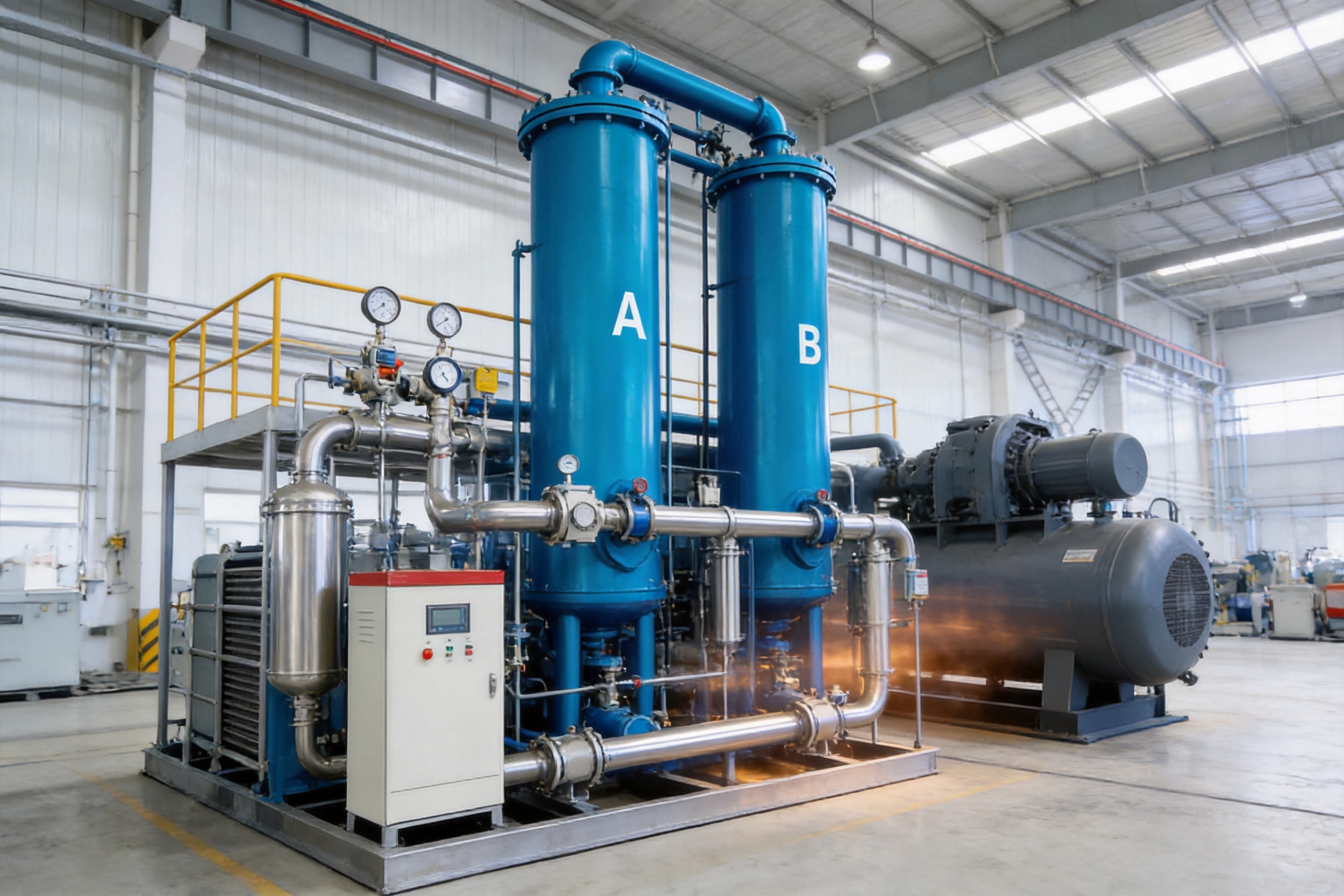
6. Competitive Position in Industrial Applications
Industrial users often compare adsorption dryers according to pressure dew point, energy consumption, air loss, reliability, footprint, maintenance requirements, automation level, and purchase cost. A system that is inexpensive to purchase may become costly if it consumes large quantities of purge air or requires frequent valve replacement. Conversely, a technically advanced system must still be properly sized and supported to deliver its expected value.
The BGD equipment is positioned around the combination of thermal regeneration and pressure swing operation. Its competitive strengths include waste heat utilization, reduced dependence on purge air, twin-tower continuous operation, optional electric heating, integrated moisture separation, and automated switching.
Compared with a heatless dryer, the equipment can potentially reduce the amount of product air used for regeneration. Compared with a purely electrically heated dryer, it can potentially reduce external power demand by using compressor exhaust heat. Compared with a single-tower intermittent dryer, its twin-tower arrangement provides continuous drying and more consistent production availability.
These advantages are most valuable when the installation has a suitable high-temperature compressor exhaust source, substantial annual operating hours, a stable compressed-air demand, and a requirement for reliable dry air. A professional technical evaluation is still necessary because the best dryer technology depends on the actual process conditions.
| Evaluation Factor | Waste Heat Regeneration Adsorption Equipment | Heatless Adsorption Dryer | Conventional Heated Adsorption Dryer | Refrigerated Dryer |
|---|---|---|---|---|
| Primary regeneration method | Compressor waste heat with pressure swing operation | Dry purge air and pressure reduction | External electric, steam, or other heating | Cooling and condensation |
| Typical energy advantage | Reuses available compressor heat | Simple process but may consume product air | Can require significant external heating power | Generally lower dew-point capability than adsorption systems |
| Product-air loss | Can be reduced through thermal regeneration | Usually includes purge-air consumption | Depends on process design | Normally no regeneration purge requirement |
| Low-dew-point capability | Suitable for demanding dry-air applications | Suitable for low dew points | Suitable for low dew points | Usually suited to moderate dew-point requirements |
| Operating flexibility | Waste heat plus optional auxiliary heating | Simple and independent of heat source | Independent of compressor exhaust heat | Dependent on refrigeration conditions |
| Main consideration | Requires proper matching with compressor heat availability | Purge-air loss and desiccant protection | External energy consumption | Limited performance under demanding low-temperature conditions |
7. Manufacturing and Engineering Strengths
7.1 Integrated Product Development
Zhejiang Baiao Gas Equipment Co., Ltd. integrates research and development, engineering design, manufacturing, installation, and after-sales service. This integrated structure is valuable for gas purification equipment because dryer performance depends on the interaction of vessels, desiccants, valves, piping, heat exchangers, controls, and operating conditions.
When these functions are managed within one organization, technical information can move more efficiently from design to production and from installation back to product improvement. The manufacturer can also coordinate equipment selection, process calculations, fabrication, control logic, testing, commissioning, and service support.
7.2 Standardized Manufacturing Facilities
The company operates a standardized workshop, office area, and warehouse in Fuyang District, Hangzhou, Zhejiang Province. A dedicated production environment supports organized material handling, component storage, vessel assembly, piping preparation, surface treatment coordination, electrical integration, inspection, and final packaging.
A structured workshop can improve production consistency by separating fabrication, assembly, testing, and dispatch activities. It also enables the company to manage multiple equipment categories, including gas separation systems, purification units, and industrial air treatment products.
7.3 Experience in Gas Separation and Purification
The company specializes in equipment for gas separation and purification. Its product portfolio includes PSA nitrogen generators, PSA oxygen generators, membrane nitrogen and oxygen generators, nitrogen purification units, and ammonia decomposition hydrogen purification units.
This broader product experience supports the design of adsorption dryers because the underlying engineering disciplines are closely related. They include pressure-vessel design, adsorbent selection, gas-flow distribution, valve sequencing, pressure control, automation, purity management, filtration, and system commissioning.
Experience across different gas applications can also help engineers understand the importance of inlet-gas quality, operating stability, contamination control, heat management, and downstream process requirements. These factors are critical in compressed-air drying as well as in nitrogen, oxygen, and hydrogen purification.
7.4 Technology Adapted to Industrial Conditions
The company develops products using overseas technologies while optimizing them for industrial conditions in China. Technology adaptation is important because a design must perform under the actual local environment rather than only under laboratory conditions.
Industrial facilities may experience high ambient temperatures, seasonal humidity, dust, variable compressor loading, voltage fluctuations, irregular maintenance practices, and changing production demand. A practical equipment design must take these factors into account through appropriate material selection, control protection, access arrangements, drainage, insulation, and service planning.
7.5 Quality Control and Process Discipline
Quality control for adsorption equipment begins with engineering calculations and continues through material purchasing, component inspection, fabrication, assembly, pressure testing, leak checking, electrical testing, control verification, and commissioning.
Important quality points include vessel integrity, weld quality, internal distribution components, valve sealing, pipe cleanliness, desiccant loading, instrument calibration, control-system logic, electrical safety, and correct labeling. A disciplined quality process helps reduce the risk of leakage, uneven air distribution, premature dew-point breakthrough, and commissioning delays.
7.6 Customized Engineering Solutions
Industrial air systems rarely have identical requirements. Flow rate, inlet pressure, pressure dew point, ambient temperature, compressor type, installation space, electrical standards, communication protocols, and local safety requirements may differ from one project to another.
The company’s design and manufacturing capabilities allow equipment to be developed for specific applications rather than treating every project as a standard package. Customization may include tower capacity, desiccant type, valve arrangement, auxiliary heating, instrument selection, control-panel configuration, skid layout, pipe connections, insulation, and monitoring functions.
7.7 Installation and After-Sales Support
Dryer performance depends not only on factory construction but also on correct installation and commissioning. The company provides installation and after-sales service as part of its integrated business model. Technical support may include site preparation guidance, piping recommendations, electrical connection checks, valve and instrument verification, start-up assistance, operator training, and maintenance advice.
After-sales support is particularly important for adsorption equipment because operating conditions can influence dew point and regeneration quality. Professional service helps users identify whether a performance issue is caused by inlet contamination, excessive flow, insufficient heat, incorrect switching, drain failure, valve leakage, sensor error, or desiccant deterioration.
8. Application Areas
8.1 Petrochemical and Chemical Production
Chemical and petrochemical plants use compressed air for instrument control, pneumatic actuators, valve operation, process automation, and equipment cleaning. Moisture can affect process stability and accelerate corrosion in instruments and pipelines.
Dry compressed air can help protect control components and reduce the risk of water-related failures. In plants where continuous operation is essential, the twin-tower dryer configuration provides a dependable source of treated air.
8.2 Textile Manufacturing
Textile facilities use compressed air in spinning, weaving, texturing, automatic control, cleaning, and packaging. Moisture may affect yarn handling, pneumatic components, and product consistency.
A properly selected adsorption dryer can provide stable air quality for production equipment, especially in regions with high humidity or large seasonal moisture variation.
8.3 Food Processing and Packaging
Compressed air may come into contact with packaging machinery, actuators, filling equipment, labeling machines, and sometimes the product environment. Moisture and contamination must be controlled according to the applicable process and air-quality requirements.
The dryer should be used together with suitable oil-removal, particulate, and hygienic filtration systems when compressed air is used in sensitive food-related applications. Dryer selection alone does not replace a complete compressed-air quality program.
8.4 Automotive Manufacturing
Automotive factories use compressed air for robotic tools, assembly stations, painting, welding support, machining, leak testing, and automated handling. Moisture can affect paint quality, pneumatic tools, control valves, and surface treatment.
Waste heat regeneration can be attractive in automotive plants because compressors often operate for long hours and provide a consistent source of recoverable heat.
8.5 Heat Treatment
Heat-treatment operations may require clean and dry instrument air for furnace controls, actuators, atmosphere-management systems, and automated handling. Uncontrolled moisture can contribute to corrosion and inconsistent process conditions.
The dryer can form part of a broader gas and air management system designed to protect sensitive controls and maintain dependable operation in high-temperature industrial environments.
8.6 SMT Electronics Manufacturing
Surface-mount technology production depends on accurate automation, pneumatic positioning, component handling, printing, inspection, and reflow-related equipment. Moisture and oil contamination can affect reliability and cleanliness in sensitive production areas.
Dry compressed air supports stable machine operation and helps reduce contamination risks when combined with suitable filtration, clean piping, and appropriate maintenance procedures.
9. System Selection Considerations
Correct sizing is essential. A dryer that is too small may experience excessive velocity, high pressure drop, incomplete regeneration, and unstable dew point. An oversized dryer may have a higher initial cost and may not operate at its most efficient cycle conditions.
The first selection parameter is compressed-air flow. The design should consider normal flow, peak flow, future expansion, and possible fluctuations. The second parameter is inlet pressure because adsorption capacity and gas volume change with pressure. The third parameter is inlet temperature, especially the temperature after the compressor aftercooler and upstream moisture separator.
Pressure dew point requirements must be clearly defined. Different processes may require different levels of dryness. Selecting a lower dew point than necessary may increase equipment cost and energy use, while selecting an insufficient dew point may expose the production system to moisture-related problems.
The availability of compressor waste heat must also be evaluated. Important factors include compressor type, exhaust-gas temperature, compressor loading, operating schedule, heat-recovery connection, exhaust cleanliness, and the distance between the compressor and dryer. If waste heat varies significantly, auxiliary electric heating may provide useful backup.
Site conditions include ambient temperature, relative humidity, altitude, available floor area, ventilation, drainage, electrical supply, noise limits, lifting access, and maintenance clearance. These details should be provided to the manufacturer before final equipment selection.
Upstream and downstream filtration should be considered as part of the complete package. Liquid water, oil, rust, and solid particles can damage the desiccant, valves, sensors, and downstream instruments. A reliable condensate-drain arrangement is equally important.
10. Installation and Commissioning
The equipment should be installed on a stable foundation with sufficient space for inspection, desiccant replacement, valve maintenance, electrical access, and safe operator movement. The piping should be adequately supported and cleaned before connection. Foreign particles left in the piping may enter the dryer and damage valves or contaminate the desiccant.
Airflow direction, inlet and outlet connections, regeneration-gas connections, condensate drains, exhaust outlets, and instrumentation lines must be checked against the approved engineering drawings. Incorrect connection of even one process line can prevent proper regeneration or create unsafe operating conditions.
Before start-up, the system should be inspected for mechanical damage, loose connections, missing labels, incorrect electrical wiring, closed drains, blocked exhaust paths, and valve-actuator problems. Instruments should be checked and calibrated according to the commissioning procedure.
The initial start-up normally includes gradual pressurization, verification of valve sequence, confirmation of regeneration temperature, inspection for leakage, review of alarm functions, and observation of the first complete operating cycles. Operators should be trained to recognize normal pressure, temperature, switching, and drainage behavior.
During commissioning, outlet dew point may require time to stabilize. The desiccant must complete one or more cycles, and the system must reach its designed thermal conditions. Performance should be evaluated under representative operating flow and compressor-load conditions rather than during an abnormal temporary state.
11. Operation and Maintenance
Routine maintenance begins with monitoring. Operators should record inlet pressure, outlet pressure, regeneration temperature, switching status, dew point where available, drain operation, and alarm history. A change in these parameters may indicate a developing problem before the production system is affected.
Filters should be inspected and replaced according to pressure drop, operating hours, contamination level, and manufacturer recommendations. A blocked filter can reduce airflow and increase energy use. A damaged or saturated coalescing filter can allow oil and liquid water to reach the desiccant.
Automatic drains should be tested regularly. Drain failure can allow liquid water to accumulate in separators and upstream piping. Manual bypass arrangements should be used only according to approved procedures because uncontrolled bypassing can send wet air directly to downstream equipment.
Switching valves require periodic inspection because they operate repeatedly. Signs of valve problems include abnormal noise, failure to reach the expected pressure, sudden dew-point deterioration, excessive exhaust flow, unstable tower switching, or continuous leakage.
The desiccant should be inspected during planned maintenance. Indicators of deterioration may include dusting, crushing, discoloration, oil contamination, reduced adsorption capacity, or increased pressure drop. Desiccant replacement intervals depend on air quality, cycle conditions, regeneration performance, and operating hours.
The control system should be protected from moisture, dust, excessive heat, and unauthorized adjustment. Alarm records should be reviewed so that recurring faults are corrected instead of repeatedly reset. Where remote communication is available, key operating data can be integrated into the plant maintenance system.
12. Energy-Saving Strategy
The energy-saving potential of a waste heat regeneration dryer is maximized when the complete compressed-air system is optimized. The compressor should operate at an appropriate pressure and load. Excessive pressure increases compressor power and may also increase dryer load.
Compressed-air leakage should be repaired because leaks increase compressor output without creating useful production. Reducing leakage can lower the moisture load entering the dryer and reduce the amount of air that must be processed.
Waste heat connections should be insulated where appropriate to prevent unnecessary heat loss. Heat exchangers and coolers should be kept clean. Poor heat transfer can lead to insufficient regeneration or increased auxiliary-heater operation.
Cycle timing should be matched to actual process conditions. If the dryer regenerates more frequently than necessary, energy and component life may be wasted. If it operates too long between switching cycles, moisture breakthrough may occur. Intelligent control and dew-point monitoring can support better cycle management.
Facilities should evaluate energy performance over a representative period. Useful indicators include dryer electrical consumption, purge-air volume, outlet dew point, pressure drop, compressor load, auxiliary-heater operating time, and maintenance frequency.
13. Safety and Reliability
Adsorption dryers operate with pressurized gas and elevated regeneration temperatures. Safety design must therefore address pressure containment, thermal protection, valve failure, electrical safety, exhaust routing, condensate handling, and emergency shutdown.
Pressure vessels and piping should be manufactured, inspected, and operated according to applicable standards and local regulations. Safety valves, pressure instruments, temperature sensors, and alarms should be correctly selected and maintained.
Hot surfaces should be insulated or guarded where necessary. Exhaust gas should be discharged to a safe location with adequate ventilation. Operators should avoid opening access points or removing covers while the equipment is pressurized or hot.
Reliability also depends on minimizing thermal shock and pressure shock. Controlled switching, gradual pressurization, correct valve timing, and proper support of piping help reduce mechanical stress. The control system should include interlocks that prevent unsafe combinations of valve positions or heating conditions.
14. Why Choose an Integrated Gas Equipment Manufacturer
Purchasing a dryer from a manufacturer with experience in gas generation and purification can provide several practical advantages. The supplier is more likely to understand how air pretreatment, adsorption, pressure control, heat management, and downstream gas quality interact.
Integrated engineering reduces the risk of gaps between separate suppliers. Instead of assigning the vessels, valves, controls, heat-recovery system, and commissioning to unrelated parties, the project can be coordinated through one technical organization.
Zhejiang Baiao Gas Equipment Co., Ltd. combines product development, design, production, installation, and after-sales service. This supports customized industrial solutions and allows the company to respond to customer requirements from the initial technical discussion through long-term operation.
The company serves industries including petrochemicals, textiles, food processing, automotive manufacturing, heat treatment, and SMT electronics. Its sales network covers numerous regions in China, and its products are also supplied to international markets. This market experience provides exposure to different operating environments, technical specifications, and customer expectations.
The company’s stated focus on technical improvement, strict quality control, integrity, energy efficiency, and reliable service is aligned with the requirements of modern industrial gas equipment. For customers, the value of a supplier is measured not only by the equipment delivered but also by the quality of technical communication, documentation, commissioning, training, and ongoing support.
15. Recommended Project Evaluation Process
A successful project should begin with a detailed information exchange. The customer should provide compressor specifications, compressed-air flow, pressure, inlet temperature, operating hours, required dew point, ambient conditions, installation location, available waste heat, electrical supply, and downstream equipment requirements.
The manufacturer can then evaluate the heat source, calculate tower capacity, determine the likely regeneration sequence, select the desiccant, define filtration requirements, and recommend the appropriate control configuration.
The next stage should include a technical proposal with process description, major equipment list, design conditions, expected performance, utility requirements, dimensions, interface points, installation requirements, and maintenance recommendations.
Before production, drawings and specifications should be reviewed and approved. This is the opportunity to confirm connection sizes, control signals, communication protocols, materials, surface treatment, insulation, access platforms, and safety requirements.
After manufacturing, inspection and testing should verify vessel integrity, valve operation, instrument response, control logic, electrical safety, and package completeness. At installation, the system should be commissioned under realistic operating conditions, and the customer’s operators should receive practical training.
16. Frequently Asked Questions
Q1: What is a waste heat regeneration dryer?
A waste heat regeneration dryer is an adsorption dryer that uses thermal energy recovered from a compressor or another industrial process to regenerate moisture-loaded desiccant. It reduces reliance on external electrical heating and can lower the amount of dried compressed air used for regeneration.
Q2: How does the BGD equipment operate continuously?
It uses two adsorption towers. One tower dries compressed air while the other tower is regenerated. After the regeneration sequence is complete, the control system switches the towers so that the regenerated tower becomes the adsorption tower and the saturated tower begins regeneration.
Q3: Is this equipment the same as a heatless adsorption dryer?
No. A heatless dryer generally regenerates its desiccant with a portion of dry compressed air and pressure reduction. The BGD equipment uses compressor waste heat as the main regeneration energy source and operates through a combination of temperature and pressure swing principles.
Q4: Is it the same as a conventional heated regeneration dryer?
No. A conventional heated regeneration dryer normally depends primarily on external electric, steam, or another supplied heat source. The BGD system is designed to use available compressor waste heat, although an auxiliary electric heater may be included for backup or special operating conditions.
Q5: What happens if the compressor does not provide enough waste heat?
The equipment can be configured with an optional auxiliary electric heating system. The heater may support startup, low-load operation, cold conditions, or periods when the compressor is unavailable. The control system can manage the heater according to temperature and operating requirements.
Q6: What industries can use this dryer?
Potential applications include petrochemical plants, chemical production, textile factories, food processing, packaging, automotive manufacturing, heat-treatment facilities, electronics production, SMT assembly, and general industrial compressed-air systems.
Q7: What information is required for equipment selection?
Important information includes compressed-air flow, operating pressure, inlet temperature, required pressure dew point, compressor type, compressor exhaust temperature, operating hours, ambient conditions, installation space, electrical supply, filtration arrangement, and future expansion plans.
Q8: Does the dryer remove oil and solid particles?
The primary function of the dryer is moisture removal. Oil aerosols, liquid water, and solid particles should be managed with suitable upstream filters, separators, and drains. Protecting the desiccant from oil and dust is essential for reliable performance.
Q9: How can operators know that the dryer is working correctly?
Operators can monitor outlet dew point, inlet and outlet pressure, regeneration temperature, switching sequence, drain operation, alarm history, and pressure drop. A sudden change in these parameters may indicate valve leakage, insufficient regeneration, filter blockage, sensor failure, or desiccant deterioration.
Q10: How often does the desiccant need to be replaced?
The replacement interval depends on inlet air quality, oil contamination, cycle frequency, regeneration temperature, pressure conditions, operating hours, and maintenance practices. Regular inspection and performance monitoring are more reliable than using a fixed interval without considering actual conditions.
Q11: Can the system be customized?
Yes. Industrial requirements may be addressed through customized tower capacity, desiccant selection, valve configuration, auxiliary heating, controls, instrumentation, communication functions, pipe connections, insulation, skid arrangement, and installation design.
Q12: Why is after-sales support important?
Correct installation, commissioning, operator training, preventive maintenance, and troubleshooting support directly affect dryer performance. An experienced supplier can help determine whether an issue is related to operating conditions, filtration, heat availability, valve function, drainage, controls, or desiccant condition.
17. Conclusion
The BGD Blower-type Thermal Regeneration Adsorption Equipment provides an energy-conscious method for producing dry compressed air in industrial environments. Its twin-tower design enables continuous adsorption and regeneration, while the use of compressor waste heat reduces dependence on external energy sources. The optional auxiliary electric heating system adds flexibility for startup, low-load operation, and changing plant conditions.
The equipment combines adsorption towers, a desiccant bed, waste heat utilization, air cooling, vapor-liquid separation, silencers, switching valves, automatic control, and air-source treatment into one coordinated system. This integrated design can support stable dew-point performance, reduced purge-air consumption, protection of downstream equipment, and improved overall compressed-air efficiency.
Its advantages are strongest when the dryer is properly matched with the compressor, air flow, pressure, temperature, dew-point requirement, and operating schedule. Correct filtration, drainage, installation, commissioning, and maintenance are equally important.
Backed by experience in gas separation and purification equipment, integrated manufacturing capabilities, customized engineering, installation support, and after-sales service, Zhejiang Baiao Gas Equipment Co., Ltd. is positioned to provide practical solutions for industrial air drying and purification projects. For facilities seeking reliable compressed air and better use of available energy, waste heat regeneration adsorption technology is a valuable option for long-term system improvement.
References
Compressed Air and Gas Institute. Compressed Air System Design and Maintenance Principles.
U.S. Department of Energy. Improving Compressed Air System Performance: A Sourcebook for Industry.
International Organization for Standardization. Compressed Air Quality and Contaminant Classification Principles.
Compressed Air and Gas Institute. Recommended Practices for Compressed Air Dryers and Treatment Equipment.
Industrial Adsorption Engineering Literature. Principles of Temperature Swing Adsorption and Pressure Swing Adsorption.
Engineering Practice Guides. Desiccant Selection, Regeneration, Moisture Control, and Compressed-Air System Reliability.
Product: BGD Blower-type Thermal Regeneration Adsorption Equipment

- Tel: +86-15057127179
+86-13588382771 - Email: huang.yifan0215@gmail.com
- Address: Huanshan Township, Fuyang District, Hangzhou City, Zhejiang Province
Copyright © Zhejiang Baiao Gas Equipment Co., Ltd. All Rights Reserved.
Privacy
Gas Generator Plant Manufacturer, Industrial Purification Equipment Plant
